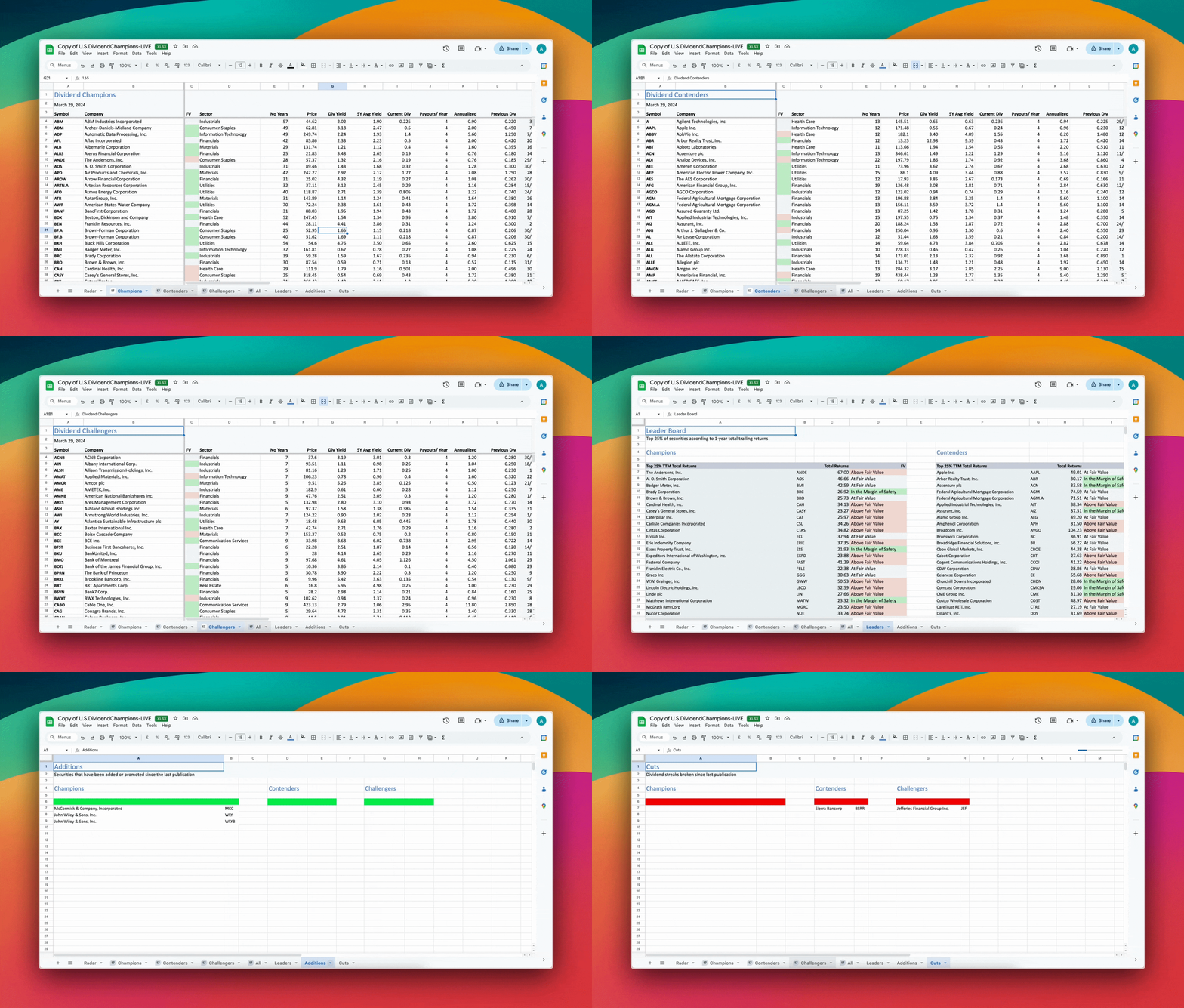
- Ashland maintains a 3.1 percent yield despite a reset year
- Free cash flow still covers the dividend even as earnings remain weak
- ASH dividends stay stable but show no signs of near term growth
Ashland dividend stability in a transitional year
Ashland continues to pay a quarterly dividend of 0.415 per share, unchanged from the prior quarter. At a share price near 52.90, the forward yield holds around 3.1 percent, placing ASH dividends in the moderate yield category for income investors.
The stock sits between higher yielding defensives such as Bristol Myers Squibb’s nearly 5 percent dividend nearly 5% dividend and peers with mid 3 percent yields following AbbVie’s 5.5 percent dividend hike 5.5% dividend hike.
However, the company has not raised its dividend recently, and the one year dividend growth rate remains negative. A roughly 23 percent decline over the past year highlights management’s priority to preserve the balance sheet during a period of earnings pressure.
Cash flow support for the ASH dividend
Ashland’s payout ratio cannot be assessed using earnings because GAAP profitability is currently negative. Yet free cash flow per share over the trailing twelve months, at about 2.06, comfortably covers the annualized dividend of 1.66.
This gives the ASH dividend a degree of security even as the company works through weaker margins.
Financial strengths include:
- Current ratio of 2.85 supporting near term liquidity
- Debt to capital of 0.44, manageable for the sector
- Cash flow stability despite negative net margins
Key challenges include:
- Net margin of negative 46 percent tied to cyclical softness and restructuring costs
- Revenue down about 14 percent year over year, limiting dividend growth potential
- A share price well below the 52 week high of 80.66, reflecting muted sentiment
Context for dividend focused investors
While biotech volatility dominated recent market action, including Exicure’s 77 percent stock collapse 77% stock collapse, Ashland’s lower beta profile offers a quieter holding for income investors. Yet ASH dividends face comparison with higher yield defensives, raising questions on whether moderate yield and negative growth adequately compensate for risk.
Dividend outlook heading into 2026
The next ex dividend date is expected on December 1, 2025, with payment scheduled for December 15. Dividend safety appears intact, but meaningful growth is unlikely until earnings stabilize.
Several indicators point to a rebuilding year.
- A blended fair value estimate of 58.87 signals moderate upside potential
- The company’s long dividend track record supports its credibility despite recent reductions
- Management is likely to wait for free cash flow acceleration before resuming dividend growth
Investor takeaway on ASH dividends
Ashland offers a steady yield around 3.1 percent, reasonable cash flow coverage and low risk of a near term payout cut. These qualities position ASH as a hold for income rather than a growth focused dividend pick.
Weak profitability, no recent increases and a downward dividend growth trend limit its appeal for investors seeking compounding through DRIP strategies or rising distributions.
Some dividend investors may prefer sectors showing stronger earnings momentum, including large cap pharma names supported by accelerating revenue engines accelerating revenue engines.
Ashland remains a stable but unspectacular dividend payer as it works through a challenging period. Investors comfortable with moderate yields and patient enough to wait for a recovery may continue to hold ASH, but those seeking dividend growth catalysts will need clearer signs of improving fundamentals.